Affiliate disclosure: This post contains affiliate links. If you buy through them, we may earn a commission at no extra cost to you.
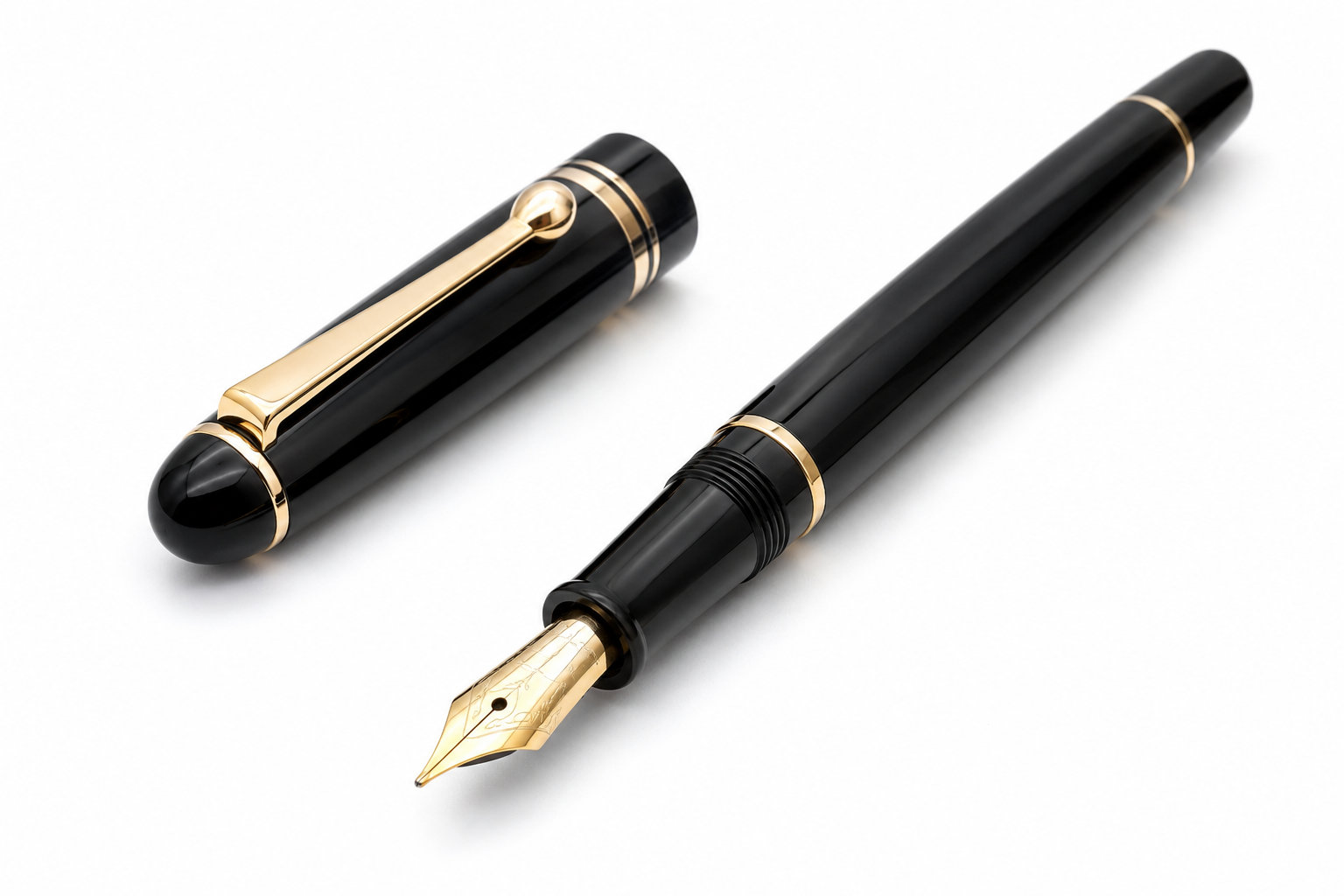
Japan’s “big three” fountain pen makers, Pilot, Platinum, and Sailor, have spent over a century refining gold nib manufacturing, and the results show. Whether you’re buying your first gold nib pen or adding to a growing collection, this guide breaks down ten Japanese fountain pens worth knowing about, from entry-level starter pens to premium gold nib writers.
What Matters Most When Choosing a Japanese Fountain Pen
Fountain pens are harder to compare than ballpoints or gel pens because the writing experience depends on several interacting factors.
Nib feel is the most obvious difference, but it is not the only one. Fine Japanese nibs are often chosen for precise writing, while broader nibs can produce a wetter and more expressive line.
The filling system also matters. Cartridge-converter pens are usually easier to clean and change inks with, while larger internal filling systems can hold more ink for frequent writing.
Cap design, body size, grip shape, and overall balance affect comfort during longer writing sessions.
For that reason, the pens in this guide are compared mainly on five factors: nib character, filling system, writing comfort, maintenance, and overall value for the intended use.
| If you prioritize… | Focus on… |
| Precise everyday writing | Fine nib control |
| Smooth, expressive writing | Nib feel and ink flow |
| Long writing sessions | Balance and grip comfort |
| Large ink capacity | Filling system |
| Easy maintenance | Cartridge-converter design |
| Premium experience | Nib, materials, and overall construction |
If you’re building out a full Japanese stationery setup, this guide pairs naturally with our best Japanese pens roundup and our guide to the best Japanese notebooks to pick paper that suits your new pen.
Why Japanese Fountain Pens Are World Famous
Three companies dominate this conversation, and each makes its own nibs in-house rather than outsourcing to a third party, a level of vertical integration few Western brands match.
- Pilot manufactures its nibs in Hiratsuka and is known for smooth, reliable gold nibs available in an unusually wide range of grades, from extra fine to specialty italic and soft nibs.
- Platinum produces its nibs in Tokyo and has built a reputation for exceptional value, offering gold nib writing quality at prices well below comparable Western pens.
- Sailor makes its nibs in Hiroshima and is best known for offering both 14K and 21K gold options, with 21K nibs prized for their springiness and feedback.
All three brands also share a design philosophy: understated, cigar-shaped bodies with the focus placed almost entirely on how the pen actually writes rather than on decoration. That’s a deliberate contrast to European brands, which often lean harder into ornamentation.
Quick Comparison Table
| Pen | Price | Nib | Best For |
|---|---|---|---|
| Pilot Custom 823 | Check current price | 14K gold | Best premium overall |
| Pilot Custom 74 | Check current price | 14K gold | Best gateway gold nib |
| Platinum 3776 Century | Check current price | 14K gold | Best value gold nib |
| Sailor 1911 Standard | Check current price | 14K gold | Best classic Japanese design |
| Sailor Professional Gear | Check current price | 14K/21K gold | Best for nib variety |
| Pilot Metropolitan | Check current price | Steel | Best budget gift |
| Platinum Preppy | Check current price | Steel | Best true beginner pen |
| Pilot Kakuno | Check current price | Steel | Best for students |
| Sailor Compass | Check current price | Steel | Best Sailor entry point |
| Platinum Procyon | Check current price | Steel | Best step-up steel nib |
Popular Japanese Fountain Pen Comparisons
- Pilot Custom 74 vs Platinum #3776 Century
- Pilot Vanishing Point vs Pilot Custom 74
- Pilot Custom 74 vs Custom 823
- Pilot Custom 823 vs Sailor Pro Gear
- Sailor Pro Gear vs Platinum #3776 Century
Current prices can vary by seller, nib, color, region, and availability, so we recommend checking the latest price before buying.
These picks are based on manufacturer specifications, published nib and fill-system details, and consistent patterns across independent pen retailer comparisons and long-running fountain pen review sites. Pricing reflects commonly seen retail ranges and can shift with sales, limited editions, and exchange rates, so treat the numbers above as a planning guide rather than a guarantee.
The Top 10 Fountain Pens
1. Pilot Custom 823 — Best Premium Overall
The Custom 823 uses a vacuum plunger filling system, an unusual mechanical design that lets the barrel hold roughly 2.5ml of ink, far more than a standard cartridge or converter pen. Its 14K nib is sized larger than the Custom 74’s and is often singled out by reviewers as one of Pilot’s smoothest writing experiences.
Specifications:
- Nib: 14K gold, available in fine, medium, and broad
- Fill system: Vacuum plunger, bottled ink
- Ink capacity: Approximately 2.5ml
- Body: Resin, demonstrator-style transparent barrel
Why it stands out: The vacuum filling system means far fewer refills for people who write a lot, and the larger nib size gives it a noticeably different feel than Pilot’s more common Custom 74.
Consider instead: If you don’t want to deal with bottled ink and a converter-free fill system, the Custom 74 offers a similar writing experience with simpler cartridge convenience.
2. Pilot Custom 74 — Best Gateway Gold Nib
Widely described by pen retailers as the standard entry point into Pilot’s gold nib lineup, the Custom 74 pairs a comfortable, slightly thicker barrel with Pilot’s well-regarded #5 nib, available in an unusually wide range of eleven nib grades on the standard black model.
Specifications:
- Nib: 14K gold, #5 size, up to 11 nib grade options
- Fill system: Cartridge/converter (CON-40 or CON-70)
- Body: Resin
Why it stands out: The sheer range of nib grades, including specialty options like soft-fine, makes this one of the most customizable entry points into gold nib writing from any brand.
Consider instead: The Platinum 3776 Century if you want a similar tier of pen at a somewhat lower price point.
3. Platinum 3776 Century — Best Value Gold Nib
Named for the height of Mt. Fuji in meters, the 3776 Century is Platinum’s flagship line and has been in continuous production since 1978, winning Japan’s Good Design Award. Its patented Slip & Seal cap mechanism is designed to keep the nib from drying out even after months of not being used.
Specifications:
- Nib: 14K gold, wide range of grades including specialty options
- Fill system: Cartridge/converter
- Special feature: Slip & Seal cap, reduces ink dry-out during storage
Why it stands out: Independent comparisons consistently note that the 3776 Century competes directly with the Custom 74 and Sailor 1911 while typically costing less, making it a common recommendation for readers comparing all three brands.
Consider instead: The Sailor 1911 Standard if nib feedback and a slightly firmer writing feel matter more to you than price.
4. Sailor 1911 Standard — Best Classic Japanese Design
Named for the year Sailor was founded, the 1911 line is the company’s core cigar-shaped pen and is available with either 14K or 21K gold nibs depending on the specific model. It’s the slimmest and lightest of the “big three” flagship pens compared here.
Specifications:
- Nib: 14K or 21K gold, depending on variant
- Fill system: Cartridge/converter
- Body: PMMA resin, available in a wide range of colors
Why it stands out: Sailor’s nibs, especially the 21K options, are frequently described as offering more spring and tactile feedback than Pilot’s or Platinum’s comparable nibs, appealing to writers who want to feel the page.
Consider instead: The Sailor Professional Gear if you want more nib grade options within the same brand.
5. Sailor Professional Gear — Best for Nib Variety
Where the 1911 line tapers to a point at both ends, the Professional Gear line uses flat caps and ends for a more angular silhouette. It’s offered in standard, slim, and King of Pen sizes, with both 14K and 21K nib options across an especially wide grade range.
Specifications:
- Nib: 14K or 21K gold, multiple sizes and grades
- Fill system: Cartridge/converter
- Body: Resin, flat-top design
Why it stands out: The sheer number of nib and size combinations makes this line a common choice for collectors who already know exactly what nib feel they’re looking for.
Consider instead: The 1911 Standard if you prefer the more traditional tapered silhouette over the flat-top design.
6. Pilot Metropolitan — Best Budget Gift
The Metropolitan pairs a solid metal body with a steel nib that reviewers consistently describe as writing well above its price point. It’s a frequent recommendation as a first “real” fountain pen or as a low-risk gift for someone who hasn’t tried one before.
Specifications:
- Nib: Stainless steel, fine or medium
- Fill system: Cartridge/converter
- Body: Brass with metal finish
Why it stands out: The weighty, all-metal body feels more substantial than most pens in its price bracket, without the fragility of a resin barrel.
Consider instead: The Pilot Kakuno if the recipient is a student or wants a lighter, more casual pen.
7. Platinum Preppy — Best True Beginner Pen
At around $5, the Preppy is frequently cited by pen retailers and enthusiast sites as the best value in fountain pens, period. It uses the same Slip & Seal cap technology found in Platinum’s flagship 3776 Century, at a fraction of the price.
Specifications:
- Nib: Stainless steel
- Fill system: Proprietary cartridge, or bottled ink with a separate converter
- Body: Clear plastic
Why it stands out: It’s hard to find a lower-risk way to find out whether you actually enjoy using a fountain pen before spending real money.
Consider instead: The Platinum Procyon once you know you like fountain pens and want a step up in build quality.
8. Pilot Kakuno — Best for Students
The Kakuno’s nib is stamped with a small smiling face, and its lightweight, faceted grip section was specifically designed to teach proper pen-holding posture. It’s marketed toward students and beginners but writes smoothly enough that many adult users keep one in regular rotation.
Specifications:
- Nib: Special alloy steel, fine or medium
- Fill system: Cartridge/converter
- Body: Lightweight resin
Why it stands out: The faceted grip section is a genuinely useful teaching tool for anyone new to holding a fountain pen correctly.
Consider instead: The Pilot Metropolitan for a more grown-up look with a similar price and nib quality.
9. Sailor Compass — Best Sailor Entry Point
Sailor has historically focused on gold nib pens, leaving the sub-$50 category mostly to Pilot and Platinum. The Compass is Sailor’s answer: a steel-nib pen that carries some of the characteristic feedback of Sailor’s gold nibs at a fraction of the price.
Specifications:
- Nib: Stainless steel, multiple grades
- Fill system: Cartridge/converter
- Body: Resin
Why it stands out: It’s one of the only ways to sample Sailor’s distinct nib feel without committing to a gold nib price tag.
Consider instead: The Sailor 1911 Standard once you’re ready to move up to Sailor’s gold nib lineup.
10. Platinum Procyon — Best Step-Up Steel Nib
Sitting between the budget Preppy and Platinum’s gold nib lineup, the Procyon offers a sportier design and a steel nib that many reviewers consider a meaningful step up in refinement from entry-level pens, without approaching gold nib pricing.
Specifications:
- Nib: Stainless steel
- Fill system: Cartridge/converter
- Body: Lightweight resin with a sport-inspired design
Why it stands out: It occupies a useful middle ground for someone who has outgrown a $5 starter pen but isn’t ready to spend $200+ on a gold nib.
Consider instead: The Platinum 3776 Century once you’re ready to move into gold nib territory within the same brand.
Buying Guide
Start with steel, move to gold. Nearly every experienced pen retailer recommends trying a steel nib pen first. Steel nibs are more forgiving of pressure and grip differences, and they let you learn what nib width and body shape you prefer before spending significantly more on a gold nib.
Understand nib sizing, not just grade. Fine, medium, and broad mean different things across brands and even across product lines within the same brand. A Japanese fine (F) nib is generally narrower than a Western fine, closer to a Western extra-fine in many cases.
Cartridge/converter vs. proprietary systems. Most of the pens on this list use a cartridge or converter system, which is straightforward and lets you switch ink colors easily. The Custom 823’s vacuum filler is the exception here, built for high ink capacity rather than convenience.
Budget for ink and maintenance. A quality bottled ink adds $10–20 to your starting cost, and pens benefit from an occasional rinse with water, especially if you switch ink colors or leave a pen unused for weeks at a time.
Buying for a gift? Steel nib pens in the $15–50 range are the safest gift choice, since nib preference is personal and a $250 gold nib pen is a bigger commitment to get right on someone else’s behalf.
FAQ
What’s the difference between a Japanese fine nib and a Western fine nib?
Japanese nibs typically run narrower than their Western counterparts at the same labeled grade. A Japanese fine is often closer to a Western extra-fine in actual line width.
Do I need special ink for Japanese fountain pens?
No. Standard fountain pen ink works in all the pens on this list, though each brand also sells its own ink lines designed to complement their pens.
Which is better for beginners, Pilot, Platinum, or Sailor?
Pilot and Platinum both offer well-regarded entry-level steel nib pens under $25. Sailor’s entry point sits higher, making Pilot or Platinum the more common recommendation for a true first fountain pen.
Are gold nibs actually better than steel nibs?
Gold nibs generally offer more flex and a softer writing feel, but a well-made steel nib can write just as reliably. The difference is more about feel than objective quality.
How long does a fountain pen nib last?
With reasonable care, a quality steel or gold nib can last decades. Nibs rarely wear out from normal use; damage usually comes from drops or being used on the wrong angle.
Can I use these pens for calligraphy?
Standard nibs on this list are designed for everyday writing rather than calligraphy, though several of these brands offer separate specialty nibs (such as Pilot’s Falcon) suited to more expressive, flexible writing.
What’s the ink capacity difference between cartridge and converter?
Cartridges are simpler but hold less ink and limit you to pre-made colors. Converters let you use any bottled ink and often hold a comparable or slightly larger amount.
Do these pens come with a warranty?
Manufacturer warranties vary by brand and retailer. Check the specific listing for coverage details before purchasing.
Final Recommendation
- Best Overall: Pilot Custom 823, for its high ink capacity and refined 14K nib.
- Best Beginner: Platinum Preppy, for the lowest-risk way to try fountain pen writing.
- Best Premium: Sailor Professional Gear, for the widest range of nib options for serious collectors.
- Best Gift: Pilot Metropolitan, for a substantial feel at an approachable price.
Whichever you choose, starting with a steel nib pen before moving to gold is the approach most retailers and long-time users recommend, and it’s the cheapest way to figure out what you actually like before committing to a bigger purchase.
Comment