Meta description: Compare Pilot Vanishing Point vs Custom 74 in 2026 for retractable convenience, gold nibs, nib choices, ink capacity, office use, and overall value.
Pilot makes two of the most respected fountain pens to come out of Japan, and they solve completely different problems. The Vanishing Point (sold as the Capless in Japan) is a retractable, knock-action fountain pen built around speed and one-handed convenience. The Custom 74 is a traditional screw-cap fountain pen built around nib choice and everyday versatility. Both use gold nibs in the versions compared here, and both are widely regarded as excellent entry points into higher-end Japanese fountain pens.
This guide is not a hands-on review. CuratePeak does not claim to have tested either pen personally. Instead, this comparison is built from Pilot’s published specifications and documented product features, organized around the practical question that actually decides most purchases: do you want instant, one-click access to a fountain pen, or a traditional capped pen with a much wider range of nib options?
Pilot sells the retractable model as the Vanishing Point in the United States and other export markets, and as the Capless in Japan. Both names refer to the same underlying mechanism.
Vanishing Point vs Custom 74 at a Glance
| Category | Better Fit |
|---|---|
| Fast access | Vanishing Point |
| Traditional fountain-pen experience | Custom 74 |
| Nib variety | Custom 74 |
| Office use | Vanishing Point |
| Long-form desk writing | Custom 74 / Depends |
| Ink capacity flexibility | Custom 74 |
| One-handed operation | Vanishing Point |
| Lighter body | Custom 74 |
| First premium Pilot | Depends |
| Overall | Depends on priorities |
Pilot Vanishing Point Overview
The Vanishing Point is Pilot’s retractable fountain pen, built around a spring-loaded knock mechanism rather than a removable cap. Pressing the knock button at the top of the pen extends the nib for writing; pressing it again retracts the nib fully into the barrel. A small door at the tip opens and closes with the mechanism, sealing the nib away when it’s retracted.
Key documented features of the current standard Vanishing Point:
- Retractable knock mechanism — no cap to remove, post, or lose
- 18K gold nib, available in current production in Extra Fine, Fine, Medium, and Broad, with additional widths such as stub offered through Pilot’s interchangeable nib units
- Airtight shutter/trapdoor design at the nib opening, intended to reduce ink drying while the nib is retracted
- CON-40 converter compatibility, alongside Pilot cartridges
- Metal barrel construction, with a clip positioned in the grip section rather than at the cap end, since there is no cap
- Interchangeable nib units — the entire nib, feed, and housing assemble as a single unit that can be swapped between compatible Vanishing Point and Decimo bodies
Do not confuse the standard Vanishing Point with the Decimo (a slimmer, lighter variant), wooden-bodied editions, or limited-run finishes. Those variants can differ in weight, diameter, and nib compatibility, and this comparison refers only to the standard model.
Pilot Custom 74 Overview
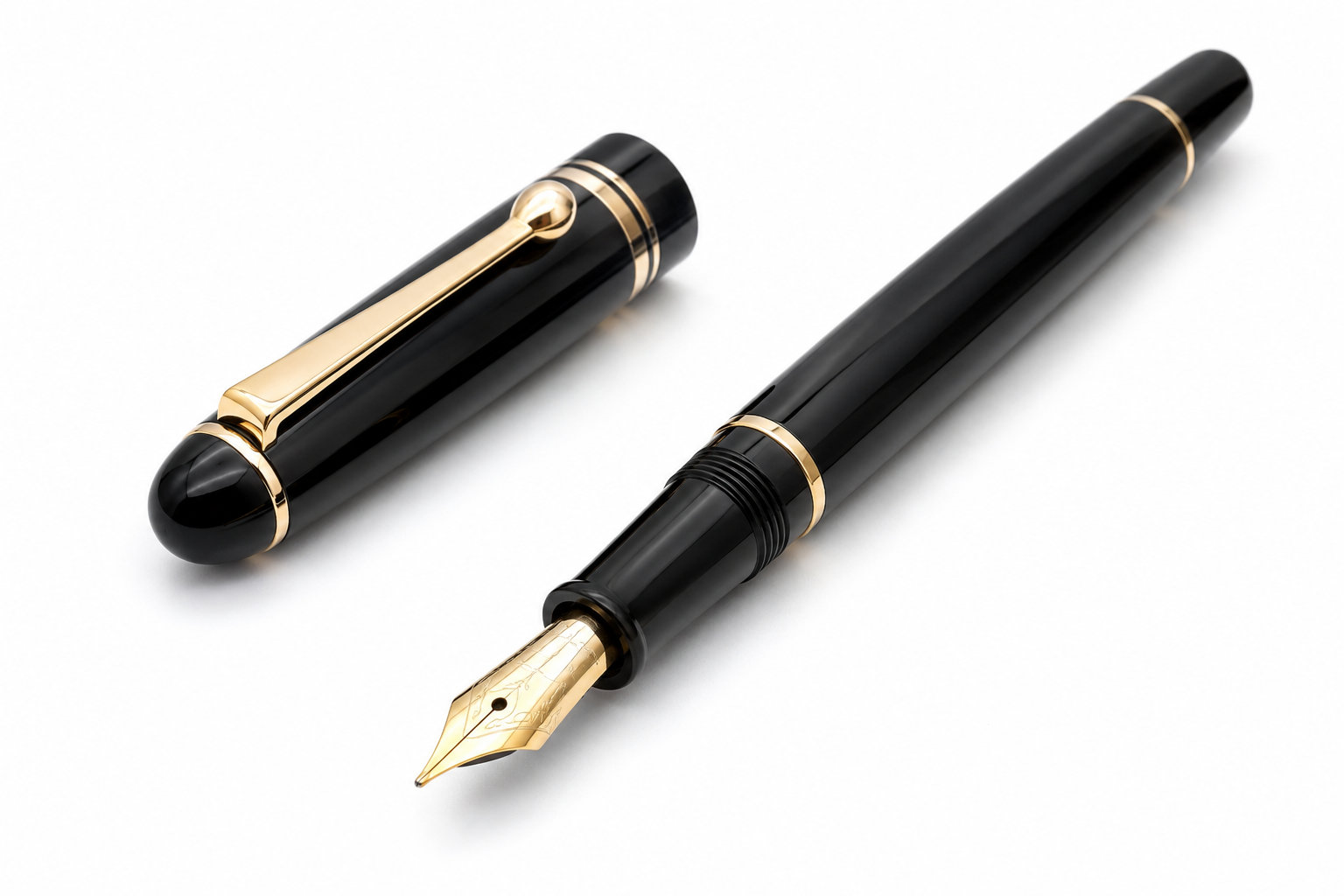
The Custom 74 is a conventional screw-cap fountain pen from Pilot’s Custom line, positioned as an accessible way to try one of Pilot’s larger #5-size nibs.
Officially confirmed specifications:
- 14K gold No. 5 nib, available in 11 nib options
- Screw-cap design with a resin barrel and cap
- CON-40 and CON-70N converter compatibility, plus Pilot cartridges
- Length: 143 mm
- Maximum diameter: 14.7 mm
- Weight: 17.4 g
The Custom 74’s defining strength is nib choice. Eleven nib options is an unusually wide spread for a pen at this price tier, ranging from fine, precise points to broader and specialty grinds.
Retractable vs Screw-Cap — The Biggest Difference
This is the section that actually decides most purchases, more than any individual spec.
Vanishing Point:
- One-click deployment — no cap to unscrew or remove
- Genuinely one-handed operation, in and out of use
- Faster transitions between writing and not writing
- No cap to misplace, post, or fumble with mid-meeting
Custom 74:
- Traditional screw-cap handling, familiar to anyone who has used a standard fountain pen
- A broader converter lineup (CON-40 and CON-70N)
- A lighter standard body at 17.4 g
This mechanism difference matters more than small specification differences elsewhere in the comparison. Everything else — nib selection, ink capacity, weight — sits downstream of this core design choice. A buyer who values speed and one-handed access will gravitate toward the Vanishing Point almost regardless of the finer details. A buyer who wants the fuller traditional fountain-pen experience, with more room to choose a specific nib character, will lean toward the Custom 74.
Nib Choice
This is where the Custom 74 has a clear structural advantage. Pilot offers 11 nib options on the Custom 74, giving buyers meaningfully more room to match a nib to their handwriting size and preferred line width — from fine, controlled writing to broader, more expressive strokes, plus specialty options.
The Vanishing Point’s current standard lineup is narrower by comparison, centered on Extra Fine, Fine, Medium, and Broad, with additional widths available through separately sold interchangeable nib units rather than as initial purchase options in every finish.
Editorial conclusion: if nib selection is your priority — for example, you want to try a specialty width or fine-tune a nib to very small or very large handwriting — the Custom 74 is structurally stronger. This is a conclusion that follows directly from the published nib lineups, not a hands-on judgment about how either nib actually writes.
Convenience for Work and Meetings
This is where the Vanishing Point’s purchase case is strongest. Pilot’s own product description frames the knock mechanism around quick, low-friction access — the pen is designed to go from pocket to page in a single motion, with no cap to manage.
For scenarios involving frequent starting and stopping — meetings, quick notes, signatures, desk-to-pocket transitions — the retractable design removes a step that a capped pen always requires. That said, CuratePeak is not asserting that this makes the Vanishing Point more comfortable to write with; comfort is a subjective, hands-on judgment that isn’t something a specifications-based comparison can responsibly claim. The convenience advantage here is about handling speed, not writing feel.
Ink Capacity and Filling Systems
Vanishing Point:
- CON-40 converter compatible
- Proprietary Pilot cartridges
Custom 74:
- CON-40 and CON-70N converter compatible
- Pilot cartridges
The Custom 74’s CON-70N compatibility is a genuine practical advantage: it’s a larger-capacity converter than the CON-40, meaning Custom 74 owners can choose a bigger ink reservoir if they don’t want to refill as often. This is one of the more concrete, spec-driven differentiators between the two pens, since it directly affects how long the pen can go between refills.
Weight and Carry
The Custom 74 has a confirmed official weight of 17.4 g, making it a notably light pen for extended desk sessions.
The Vanishing Point’s standard model, by contrast, is a metal-bodied pen and is documented across multiple retailers and reviewers in the neighborhood of 30 g — roughly 70% heavier than the Custom 74. That weight comes from the retractable mechanism itself, which requires a metal housing and internal spring assembly that a simple capped resin pen doesn’t need.
For pocket carry and quick, short writing bursts, the Vanishing Point’s heavier build is rarely an issue in practice. For longer desk-based writing sessions, some users find a lighter pen less fatiguing over time — but CuratePeak is not asserting that the Custom 74 is definitively more comfortable for long sessions, since comfort over time varies by grip and hand size. The weight difference is a documented fact; how much it matters to any individual writer is not something a specifications comparison can settle.
Writing Character
Writing feel is the one area where this comparison stays deliberately limited. Nib geometry, tipping material, and the manufacturer’s own published nib descriptions are the only reliable inputs available without hands-on testing — and CuratePeak does not claim to have tested either pen.
What can be said from specifications alone: the Custom 74’s 11-nib lineup gives it a structurally wider range of possible writing characters out of the box, simply because there are more nib geometries to choose from. The Vanishing Point’s narrower standard lineup means the writing character is more fixed unless a buyer separately purchases additional interchangeable nib units.
Which Is Better for Office Use?
Vanishing Point tends to fit better for:
- Frequent short notes throughout the day
- Meetings and stop-start writing
- Signatures
- One-handed deployment while holding a phone, folder, or coffee in the other hand
Custom 74 tends to fit better for:
- Desk-based, longer-form writing
- Users who want to select a specific nib character
- Users who want CON-70N’s larger ink capacity for fewer refills
Which Is Better for Students or Note-Taking?
Both pens sit at a premium price point that makes them a bigger commitment than a typical student pen, so this isn’t primarily a student-budget comparison. Within that context, the deciding factors are note volume, how often refilling is convenient, whether cap-handling fits a fast-paced note-taking environment, and how much a specific nib width matters. High-volume, fast note-takers who dislike managing a cap may prefer the Vanishing Point’s retractable design; those prioritizing a specific, fine or extra-fine nib for small, dense handwriting may prefer the Custom 74’s wider nib selection.
Which Is Better as Your First Gold-Nib Pilot?
Choose the Vanishing Point if:
- Convenience is the main reason you want a premium pen in the first place
- Work and meetings dominate your writing use
- The retractable, cap-free design genuinely appeals to you
Choose the Custom 74 if:
- You want room to explore different nib choices
- You prefer the traditional fountain-pen format
- Ink capacity and refill flexibility matter to you
- You want a lighter standard body
These Pens Solve Different Ownership Problems
The Vanishing Point solves the friction of using a fountain pen frequently throughout the day — it removes the cap-handling step entirely and turns a fountain pen into something closer to a knock-action ballpoint in terms of speed.
The Custom 74 solves a different problem: choosing a premium Pilot fountain pen built around your preferred nib and a traditional writing setup, with more room to fine-tune the writing experience through nib selection and a larger converter option.
Neither problem is more legitimate than the other — they’re just different reasons to own a premium pen.
Price and Value
Prices for both pens vary by nib width, finish, seller, and region, so CuratePeak does not list fixed pricing here. Checking current listings directly is the most reliable way to compare value at the time of purchase.
Check Pilot Vanishing Point on Amazon →
Check Pilot Custom 74 on Amazon →
Final Verdict
There isn’t a single universal winner between these two pens, because they’re built around different priorities. If one-handed speed, cap-free convenience, and quick stop-start use define how you’ll actually use a fountain pen day to day, the Vanishing Point is the stronger structural fit. If you want the broadest nib selection, a lighter standard body, and the larger CON-70N converter option, the Custom 74 is the stronger structural fit.
Check Pilot Vanishing Point on Amazon →
Check Pilot Custom 74 on Amazon →
Related reading:
- Pilot Custom 74 vs Platinum #3776 Century
- Best Japanese Fountain Pens
- Best Luxury Japanese Fountain Pens
- Best Japanese Pens
- Best Japanese Pens as Luxury Gifts
- Best Premium Japanese Gifts
Frequently Asked Questions
Is the Pilot Vanishing Point better than the Custom 74?
Neither pen is universally better — they’re built for different priorities. The Vanishing Point favors speed and one-handed, cap-free convenience. The Custom 74 favors nib variety, a lighter body, and greater ink-capacity flexibility.
Is the Vanishing Point the same as Pilot Capless?
Yes. Pilot sells the same retractable fountain pen as the Vanishing Point in the United States and other export markets, and as the Capless in Japan.
Which has more nib options?
The Custom 74, with 11 nib options versus the Vanishing Point’s narrower standard lineup of Extra Fine, Fine, Medium, and Broad.
Which is better for work?
The Vanishing Point’s retractable, one-handed design tends to fit fast-paced office use — meetings, quick notes, and frequent stop-start writing — better than a capped pen.
Which has better ink capacity?
The Custom 74 supports both the CON-40 and the larger CON-70N converter, giving it more flexibility for extended use between refills. The Vanishing Point is limited to CON-40 compatibility.
Which is better for everyday writing?
It depends on what “everyday” means for you. Frequent short bursts of writing throughout the day favor the Vanishing Point’s convenience. Longer, desk-based everyday writing sessions may favor the Custom 74’s lighter body and nib selection.
Which is better as a first gold-nib fountain pen?
If convenience and retractable design are the main draw of owning a premium pen, start with the Vanishing Point. If you want to explore nib choice and a traditional format, start with the Custom 74.
Does the Vanishing Point dry out?
Pilot’s design includes an airtight shutter mechanism at the nib opening specifically intended to reduce ink drying while the nib is retracted, though CuratePeak has not independently tested drying performance over time.
Does the Custom 74 use CON-70N?
Yes. The Custom 74 is compatible with both the CON-40 and the larger-capacity CON-70N converter.