Meta description: Compare Pilot Custom 823 vs Sailor Pro Gear in 2026 for gold nibs, nib choices, ink capacity, filling systems, daily writing, and overall value.
The Pilot Custom 823 and the Sailor Professional Gear are both premium Japanese gold-nib fountain pens, but they come from different brands with different design philosophies — and this comparison is the first in this series to cross that line. Where the earlier Custom 74 vs Custom 823 comparison stayed within Pilot’s own lineup, this one asks a bigger question: when you’re choosing between Japan’s two most respected fountain pen makers at this price point, what actually separates them?
The short version: the Custom 823 emphasizes ink capacity and sustained writing through its built-in plunger filling system. The Sailor Professional Gear emphasizes nib variety and conventional cartridge/converter ownership. Neither pen is a strict upgrade over the other — they solve different ownership problems.
This comparison is built from Pilot’s and Sailor’s official published specifications. CuratePeak is not claiming hands-on testing of either pen; the aim is to lay out what’s actually documented so a reader comparing these two can make an informed decision.
Custom 823 vs Sailor Pro Gear at a Glance
| Category | Better Fit |
|---|---|
| Ink capacity | Custom 823 |
| Nib variety | Sailor Pro Gear |
| Larger nib platform | Custom 823 |
| Specialty nib choices | Sailor Pro Gear |
| Heavy daily writing | Custom 823 |
| Cartridge convenience | Sailor Pro Gear |
| Simple ink changes | Sailor Pro Gear |
| Long writing sessions | Custom 823 |
| Fine-writing choice | Sailor Pro Gear |
| Overall | Depends on priorities |
Pilot Custom 823 Overview
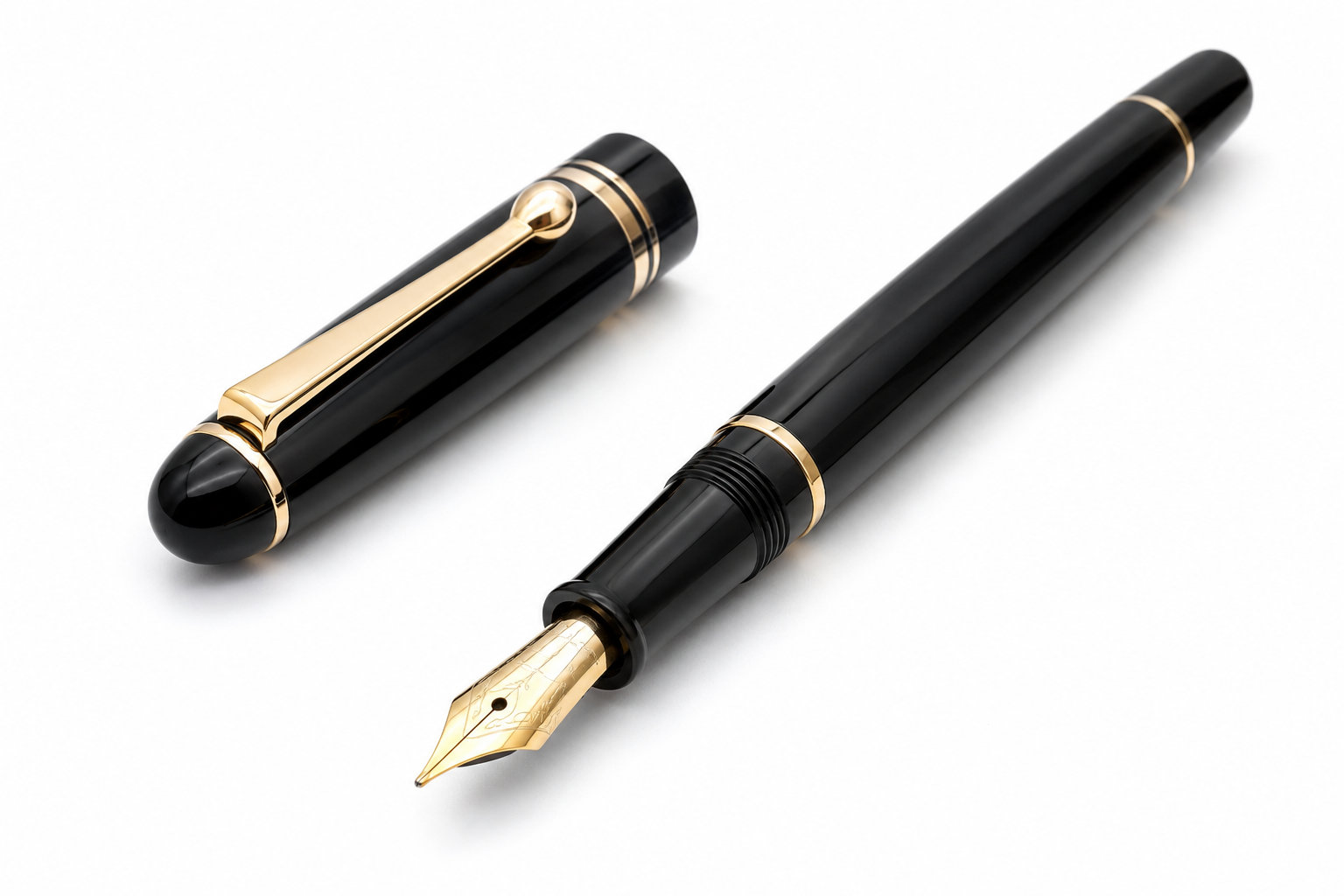
The Custom 823 is part of Pilot’s Custom family, built around a large nib and a filling system designed for sustained, high-volume writing.
Officially confirmed specifications:
- 14K gold No. 15 nib
- Current standard nib lineup: Fine, Medium, Broad, and Signature
- Vacuum plunger filling system, drawing ink directly from a bottle into a large internal reservoir
- Screw-cap design with a resin body and cap
- Length: 148.4 mm
- Maximum diameter: 15.7 mm
- Weight: 29.5 g
Pilot positions the 823’s high-capacity ink system specifically around heavy use — this is a pen designed for writers who don’t want to refill often.
Sailor Pro Gear Overview
The Professional Gear is Sailor’s best-known fountain pen line, distinguished by a flat-top, cut-away cap design with the brand’s inlaid anchor logo, and available in either 21K or 14K gold nibs depending on configuration. This comparison covers the standard 21K Professional Gear model.
Officially confirmed specifications:
- 21K gold nib, with a current standard lineup of Extra Fine, Fine, Medium-Fine, Medium, Broad, Zoom, and Music
- PMMA resin construction
- Cartridge/converter filling system
- Screw-cap design with Sailor’s signature flat-top, cut-away cap profile
Note that this comparison refers specifically to the standard Professional Gear model. Do not confuse it with the Pro Gear Slim (a smaller, lighter 14K variant), the King of Pen (a larger, higher-gold-content flagship), the Realo (a piston-filling variant), or limited editions — all of which differ in size, nib platform, or filling mechanism from the standard model compared here.
14K No.15 vs 21K — What Actually Matters?
This is the comparison readers search for most, and it’s worth being precise about what the difference actually means before drawing conclusions.
Gold purity (14K vs 21K) affects the alloy composition of the nib, but it does not by itself determine how a nib writes. Nib geometry, tipping material, tine grinding, and the manufacturer’s specific tuning all play a role — and none of that can be responsibly assessed without hands-on testing, which this comparison does not claim.
What can be said from specifications alone:
- The Custom 823’s No. 15 nib is a physically large nib platform, with a narrower current standard selection (Fine, Medium, Broad, Signature)
- The Sailor Pro Gear’s 21K nib comes in Sailor’s full standard range — Extra Fine, Fine, Medium-Fine, Medium, Broad, Zoom, and Music — the widest nib selection in this comparison
21K gold does not automatically mean a softer, smoother, or objectively “better” nib than 14K. That’s a claim about writing feel that would require hands-on comparison to responsibly make, and this article isn’t making it. What the specifications do show clearly is that Sailor offers meaningfully more nib width options on its standard 21K platform than Pilot does on the Custom 823.
Nib Selection — Sailor Pro Gear’s Biggest Advantage
Sailor Professional Gear: Extra Fine, Fine, Medium-Fine, Medium, Broad, Zoom, Music — seven standard nib grades.
Pilot Custom 823: Fine, Medium, Broad, Signature — four standard nib grades.
This is a clear, specification-driven gap. Sailor’s Zoom nib (a faceted, italic-like grind) and Music nib (a stub-style nib for calligraphic line variation) give the Pro Gear access to specialty writing styles that the Custom 823’s current lineup doesn’t offer in its standard configuration. For readers interested in small handwriting, broad expressive strokes, or specialty calligraphic writing, nib variety clearly favors the Pro Gear.
Filling System — Custom 823’s Biggest Advantage
Custom 823: Built-in vacuum plunger, filling directly from a bottle into a large internal reservoir.
Sailor Pro Gear: Cartridge/converter system, compatible with Sailor’s proprietary cartridges or a converter for bottled ink.
The practical trade-offs:
- Capacity: the 823’s plunger reservoir holds substantially more ink than a standard converter, meaning fewer refills over time
- Refill frequency: lower for the 823, higher for the Pro Gear under similar writing volume
- Ease of changing ink: the Pro Gear’s cartridge/converter system makes switching ink colors quick and simple; the 823’s plunger system is more involved to empty, clean, and refill with a different ink
- Cleaning: the 823 generally requires more thorough periodic maintenance than a converter swap
- Travel: cartridges travel more easily than committing to a bottle of ink
- Bottled ink dependence: the 823 requires bottled ink; the Pro Gear can run on cartridges or a converter
The clearest way to frame this: the Custom 823 means fewer refills, while the Sailor Pro Gear means easier ink switching and cartridge convenience.
Ink Capacity and Heavy Use
This is the Custom 823’s strongest structural advantage. Pilot explicitly positions the 823’s plunger system around heavy use, and its documented ink capacity is substantially larger than what a cartridge or standard converter provides.
This matters most for specific writing patterns: long journaling sessions, academic or research writing, extended daily note-taking, and any use case where refilling mid-session is a genuine interruption rather than a minor pause. Writers who fall into these categories and who don’t mind bottled ink stand to benefit the most from the 823’s capacity advantage.
Writing Character and Feedback
Sailor nibs are commonly discussed in the broader pen community for a more tactile, textured writing character — sometimes described using the term “feedback” to refer to a nib’s tactile resistance against paper — while Pilot’s larger nib platforms are generally discussed in different terms. CuratePeak has not tested either pen and is not asserting a writing-feel conclusion here; this is a note about how each brand’s nibs are commonly discussed publicly, not a first-hand claim about how they perform.
Size and Everyday Ownership
Official Pilot Custom 823 dimensions: 148.4 mm length, 15.7 mm maximum diameter, 29.5 g weight.
For the standard Sailor Professional Gear, official manufacturer data confirms it is built on PMMA resin with a cartridge/converter filling system, though a single universal weight and length figure is harder to pin to one number across every finish and nib configuration Sailor offers. Rather than estimate, the safest statement supported by available manufacturer information is that the standard Professional Gear is a conventional cartridge/converter fountain pen sized comparably to other full-size Japanese fountain pens in this tier — buyers who want an exact figure for a specific colorway should check that model’s individual listing.
Which Is Better for Daily Writing?
Custom 823 tends to fit better for:
- Very high daily writing volume
- Writers comfortable committing to bottled ink
- Wanting fewer refills overall
- A preference for a larger-body pen
Sailor Pro Gear tends to fit better for:
- Writers who enjoy experimenting with different nib grinds
- Frequent ink color changes
- Cartridge convenience for travel or quick refills
- Interest in specialty nibs like Zoom or Music
Which Is Better for Fine Writing?
Both pens offer genuinely fine standard nib options — the Custom 823’s Fine and the Sailor Pro Gear’s Extra Fine and Fine grades. But it’s worth being clear that Japanese nib labels are not standardized across brands. A “Fine” from Pilot and an “Extra Fine” from Sailor do not necessarily produce identical line widths; nib width designations vary by manufacturer, and even by model line within the same manufacturer. Readers choosing based on line width alone should look at manufacturer-published line-width charts or writing samples for the specific model, rather than assuming labels translate directly between brands.
Which Is Better for Work?
For meetings, desk-based writing, and signatures, both pens perform the roles a premium fountain pen typically fills. The differentiators are practical: the Custom 823’s larger ink capacity suits long-form desk writing without interruption, while the Sailor Pro Gear’s cartridge convenience makes it easier to keep multiple ink colors on hand or refill quickly between meetings. Portability is roughly comparable between the two, as both are full-size fountain pens rather than compact or slim models.
Which Is Better as Your First Premium Japanese Fountain Pen?
Choose the Custom 823 if you:
- Already know your preferred nib size and characteristics
- Write a lot and want to minimize refill frequency
- Want a built-in, high-capacity filling system
- Are drawn to the plunger-fill mechanism itself
Choose the Sailor Pro Gear if you:
- Want to explore a wide range of nib choices before settling on a preference
- Are specifically interested in Extra Fine, Zoom, or Music nibs
- Prefer the flexibility of cartridges and converters
- Want easier day-to-day ink changes
These Pens Optimize Different Parts of Fountain-Pen Ownership
The Custom 823 reduces how often you have to think about ink capacity — fill it once, and write for a long time before needing to think about it again.
The Sailor Pro Gear gives you more ways to decide how the nib itself should write — with seven standard grinds to choose from, ownership here is about tuning the writing experience itself rather than minimizing maintenance.
Is the Custom 823 or Pro Gear Better Value?
Current prices vary by nib, finish, seller, and region, so CuratePeak does not list fixed pricing here. Rather than comparing sticker price alone, the more useful value comparison is structural: the nib platform, the filling system, the available nib range, and how each pen fits your intended use.
[Check Pilot Custom 823 on Amazon →]
[Check Sailor Pro Gear on Amazon →]
Choose the Pilot Custom 823 If…
- You write heavily
- You want high ink capacity
- You prefer a built-in filling system
- You already know your nib preference
- You want a larger Pilot No. 15 nib platform
Choose the Sailor Pro Gear If…
- You want more nib choices
- Extra Fine, Zoom, or Music interests you
- You change ink frequently
- Cartridge compatibility matters
- You want Sailor’s 21K Professional Gear platform
[Check Pilot Custom 823 on Amazon →]
[Check Sailor Pro Gear on Amazon →]
Related reading:
- Pilot Custom 74 vs Custom 823
- Pilot Custom 74 vs Platinum #3776 Century
- Pilot Vanishing Point vs Pilot Custom 74
- Best Japanese Fountain Pens
- Best Luxury Japanese Fountain Pens
- Best Japanese Pens
- Best Premium Japanese Gifts
Frequently Asked Questions
Is Pilot Custom 823 better than Sailor Pro Gear?
Neither is universally better — the Custom 823 offers a larger nib and much higher ink capacity, while the Sailor Pro Gear offers a wider nib selection and conventional cartridge/converter convenience.
Is a 21K nib better than a 14K nib?
Not automatically. Gold purity is one factor among several — including nib geometry and tipping — that shape how a nib writes, and purity alone doesn’t determine writing quality.
Which has more nib options?
The Sailor Pro Gear, with seven standard nib grades (Extra Fine, Fine, Medium-Fine, Medium, Broad, Zoom, Music) versus the Custom 823’s four (Fine, Medium, Broad, Signature).
Which has more ink capacity?
The Pilot Custom 823. Its built-in vacuum plunger system holds substantially more ink than the Sailor Pro Gear’s cartridge or converter.
Which is better for fine writing?
Both offer genuinely fine nib options, but nib width labels aren’t standardized across brands — a Pilot Fine and a Sailor Extra Fine aren’t guaranteed to produce the same line width.
Which is better for daily writing?
It depends on your writing volume and ink habits. High-volume writers who don’t mind bottled ink may prefer the Custom 823; writers who value nib variety and cartridge convenience may prefer the Pro Gear.
Which is easier to refill?
The Sailor Pro Gear, thanks to its cartridge/converter system. The Custom 823’s plunger fill takes longer and requires bottled ink.
Which is better for beginners?
The Sailor Pro Gear’s cartridge/converter system is generally a more familiar, lower-commitment entry point than the Custom 823’s plunger mechanism, which requires bottled ink from the start.
Does the Custom 823 use cartridges?
No. The Custom 823 uses a built-in vacuum plunger filling system and draws ink directly from a bottle.
Does Sailor Pro Gear use a converter?
Yes. The standard Sailor Professional Gear is compatible with both Sailor’s proprietary cartridges and a converter for bottled ink.