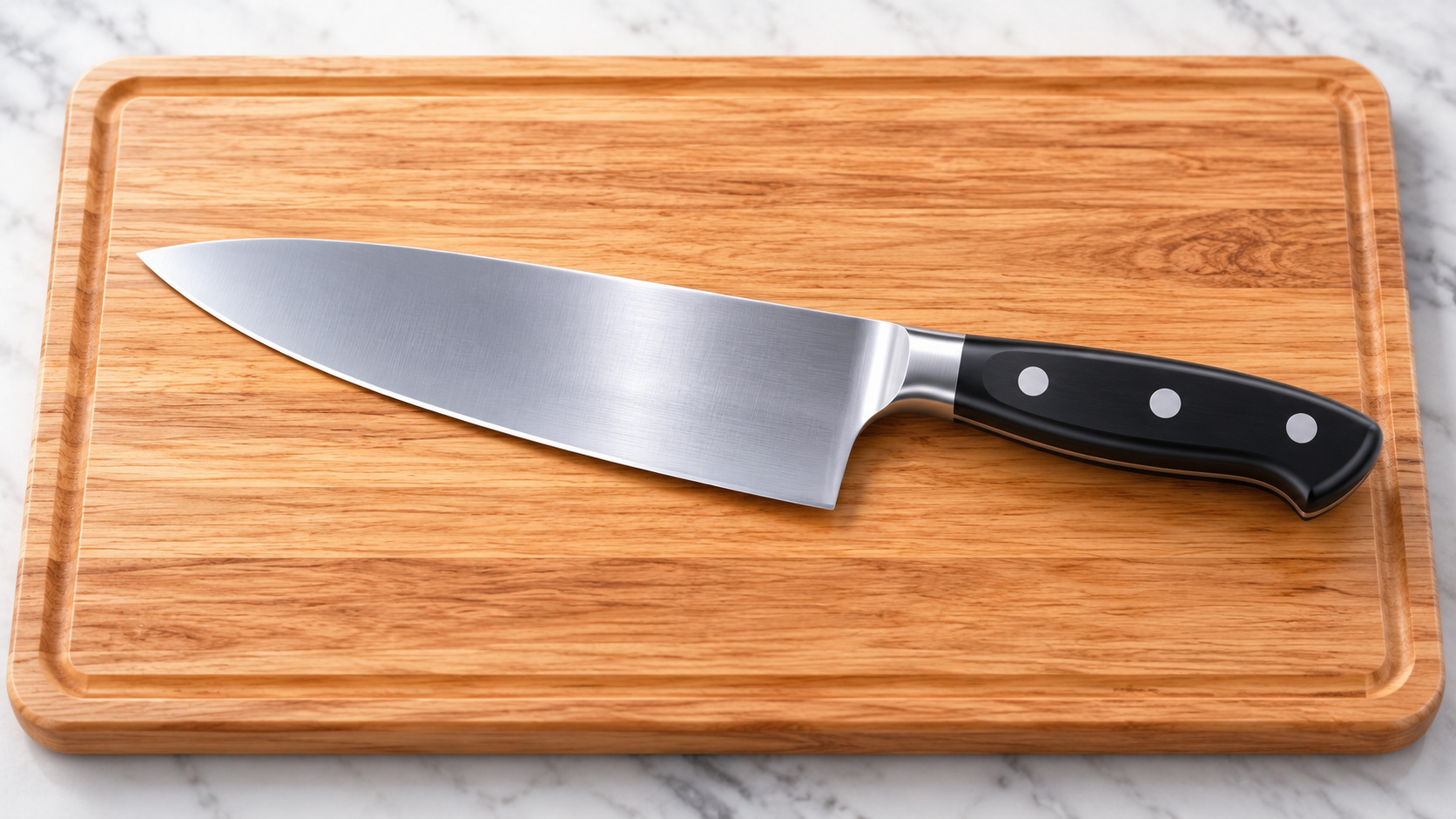
If you’re buying your first Japanese kitchen knife, the choice usually comes down to two names: gyuto and santoku. Both are considered general-purpose knives capable of handling most everyday prep work, but they come from different design traditions and are genuinely better suited to different kitchens, cooking styles, and hand sizes.
The confusion is understandable. Both knives get described as “all-purpose,” both show up constantly in Japanese knife recommendations, and both can technically cut meat, fish, and vegetables. But the details that separate them — blade length, tip shape, weight distribution, and the cutting motion each one is built around — have a real, practical effect on which one feels natural in your hand and which one actually gets reached for on a Tuesday night.
This guide breaks down where each knife came from, how their blade geometry differs, and which one is likely to serve you better based on how you actually cook — using published specifications and established culinary references rather than personal testing.
For a broader look at Japanese chef knives as a category, see our best Japanese chef knives for home cooks guide, which covers specific models across both styles.
[Image suggestion: side-by-side photo of a gyuto and santoku blade showing the profile difference]
What Is a Gyuto?
Origins: The gyuto emerged during Japan’s Meiji era (1868–1912), when the country opened to Western trade and beef consumption became more common in the Japanese diet. It was developed as a Japanese take on the European chef’s knife, built with Japanese steel and blade geometry. The name (牛刀) translates literally to “cow sword” or “beef knife,” reflecting its original purpose.
Typical Blade Length: Gyuto blades generally range from 180mm to 270mm (7–10.5 inches), with 210mm and 240mm being the most common sizes for both home kitchens and professional use. Shorter 180mm versions suit smaller kitchens, while 240mm and longer are typically reserved for cooks working with larger cuts of food.
Strengths:
- Curved belly supports rock-chopping, the same forward-and-back motion used with Western chef’s knives
- Pointed tip allows for precision work, piercing, and detail cutting
- Longer blade covers more surface area per stroke, useful for large cuts of meat or produce
- Thinner, lighter blade than a comparable Western chef’s knife, while retaining a similar overall shape
Weaknesses:
- Longer blade requires more cutting board and counter space
- Can feel unwieldy for cooks with smaller hands or limited knife experience
- Requires steadier, more consistent angle control when sharpening due to the longer edge
What Is a Santoku?
Origins: The santoku appeared in Japan in the mid-20th century, after World War II, as a home cook’s alternative to the traditional nakiri vegetable knife. It kept the nakiri’s straight edge and height but added a curved “sheep’s foot” tip. The name (三徳) translates to “three virtues,” generally understood to reference either the three ingredients it handles well — meat, fish, and vegetables — or the three techniques it performs — slicing, dicing, and mincing.
Typical Blade Length: Santoku blades typically run 150mm to 180mm (5.5–7 inches), noticeably shorter than a gyuto. Most home cooking versions fall in the 165–180mm range. Santoku knives are also generally lighter, often in the 100–170g range compared to a heavier gyuto of similar quality.
Strengths:
- Compact size requires less counter space and is easier to store
- Lighter weight and shorter blade make it more approachable for beginners or smaller hands
- Flat edge profile supports controlled, straight up-and-down cuts, well suited to dicing vegetables
- Often includes a granton edge (small oval divots) that helps reduce food sticking to the blade
Weaknesses:
- Shorter blade struggles more with large cuts of meat or oversized produce like squash or watermelon
- Rounded sheep’s foot tip is less suited to precision piercing or detail work than a pointed gyuto tip
- Flatter profile means less natural support for rock-chopping technique
[Image suggestion: illustration comparing gyuto’s curved belly vs santoku’s flat sheepsfoot profile]
Quick Comparison Table
| Gyuto | Santoku | |
|---|---|---|
| Blade Length | 180–270mm (7–10.5 in) | 150–180mm (5.5–7 in) |
| Weight | Heavier, more blade mass | Lighter, 100–170g typical |
| Tip Shape | Pointed, curved belly | Sheep’s foot, flat edge |
| Best Uses | Meat, large produce, rock-chopping | Vegetables, herbs, controlled chopping |
| Ease of Use | Moderate learning curve | Beginner-friendly |
| Price Range | $60–300 | $50–250 |
Gyuto vs Santoku: Side-by-Side Comparison
Meat
The gyuto’s pointed tip and curved belly make it better equipped for larger cuts of meat, including portioning poultry or slicing roasts, where a longer blade reduces the number of strokes needed and helps preserve texture. Fewer strokes through a piece of meat generally means less tearing at the muscle fibers and a cleaner final cut, which matters more with larger roasts than with something like a single chicken breast. The santoku can still handle boneless meat and smaller cuts, but its shorter blade and flatter profile are less efficient with larger proteins — you’ll often need more passes to get through the same cut, and the shorter length limits how large a single slice can be.
Fish
Both knives can handle boneless fish fillets reasonably well, though neither is a dedicated substitute for a specialized fish knife like a deba or sujihiki, which are purpose-built for breaking down whole fish and handling the more delicate, glossy cuts used in sashimi preparation. The santoku’s shorter, more controlled blade suits smaller, delicate cuts and precise portioning, while the gyuto’s longer edge is useful for cleanly portioning larger fish in a single motion rather than several shorter cuts.
Vegetables
This is where the santoku tends to edge ahead. Its flat cutting edge and sheep’s foot tip support a straight up-and-down chopping motion that’s well suited to dense vegetables like cabbage or carrots, and the wider blade profile gives your knuckles more clearance above the cutting board during repetitive chopping. The gyuto can absolutely handle vegetables too — its thin blade geometry passes cleanly through dense produce without wedging or splitting — but the technique leans more toward the rocking motion associated with Western knife styles, which some cooks find takes longer to master for high-volume vegetable prep.
Beginners
The santoku’s shorter blade, lighter weight, and more predictable straight-cutting motion generally make it the easier knife to pick up for someone new to Japanese knives. There’s less blade to manage, less weight to control, and the flatter edge doesn’t require learning the rocking technique that a curved gyuto belly is built around. The gyuto’s longer blade and rock-chopping technique typically take more time to feel natural, particularly for cooks whose prior experience is limited to shorter Western paring or utility knives.
Small Kitchens
The santoku’s compact size is a practical advantage in kitchens with limited counter and cutting board space, and it’s easier to store safely in a knife block or drawer. A 240mm gyuto, by comparison, needs more room to maneuver without hitting cabinets or crowding other tools on a crowded counter, and a shorter cutting board may not comfortably accommodate its full blade length during longer cutting strokes.
Versatility
The gyuto is generally considered the more versatile knife across a wider range of cutting tasks, largely due to its longer blade and pointed tip, which allow it to handle everything from detail work to large-format cutting without switching tools. The santoku is versatile within its size class — genuinely capable with meat, fish, and vegetables — but its shorter blade puts a ceiling on the scale of what it can efficiently handle, which is why cooks who prepare larger quantities or bigger cuts of food tend to eventually add a gyuto to their collection even if they started with a santoku.
Price and Value
Both knife styles span a similarly wide price range, from entry-level stainless models under $100 to premium hand-forged blades well over $300. At a given price point, the two styles are generally comparable in materials and construction quality — the price difference between a gyuto and a santoku from the same manufacturer and steel type is usually minor. The bigger value consideration is whether the knife style matches how you actually cook, since even a premium blade in the wrong shape for your needs will see less use than a more modest knife that fits your workflow.
[Image suggestion: size comparison graphic showing average gyuto and santoku blade lengths side by side]
Blade Steel, Edge Angle, and Maintenance
Beyond length and shape, both knife styles are available across a similar range of steel types, and the steel choice matters as much as the blade profile when it comes to day-to-day use.
Steel options for both gyuto and santoku typically span stainless blends like VG-10 and AUS-10, high-carbon options like Aogami (Blue Steel) or Shirogami (White Steel), and damascus-patterned laminated steels that combine a hard cutting core with softer, more flexible outer layers. Stainless options tend to be lower-maintenance and more resistant to staining, while carbon steel options generally hold a sharper edge longer but require more diligent drying and oiling to prevent rust.
Edge angle and sharpening differ slightly between the two styles mostly because of blade length rather than steel. A gyuto’s longer edge demands a steadier, more consistent angle across the full length of the blade when sharpening, which can be trickier for someone new to whetstone sharpening. A santoku’s shorter edge is generally easier to keep consistent, simply because there’s less blade to maintain a single angle across.
Handle style varies by manufacturer rather than by knife type — both gyuto and santoku are available with traditional Japanese-style handles (often octagonal or D-shaped, made from magnolia or other lightweight woods) or Western-style handles more similar to what’s found on a European chef’s knife. Traditional handles tend to be lighter and shift the balance point slightly toward the blade, while Western handles offer a grip more familiar to cooks coming from non-Japanese knives.
Regardless of which style you choose, proper care matters more for long-term performance than the blade shape itself: hand-washing and drying immediately after use, storing the blade in a way that protects the edge (a sheath, block, or magnetic strip rather than a loose drawer), and regular honing between sharpenings will extend the life of either knife considerably.
Which Knife Should You Choose?
Best for Beginners: Santoku
The lighter weight, shorter blade, and more intuitive straight-chopping motion make the santoku an easier knife to get comfortable with, especially for cooks who haven’t used a Japanese-style knife before.
Best for Experienced Cooks: Gyuto
Cooks who already have knife skills and want one blade that can handle everything from delicate vegetable prep to breaking down larger cuts of meat will generally get more out of a gyuto’s longer, more versatile blade.
Best All-Around Choice: Gyuto (210mm)
If you can only own one Japanese knife and want the widest range of capability, a mid-sized 210mm gyuto is the size most frequently recommended as the all-purpose sweet spot — long enough for larger tasks, without being unwieldy for daily use.
That said, plenty of home cooks find that owning both — a santoku for daily vegetable-heavy prep and a gyuto for larger cutting tasks — covers nearly everything a Japanese knife collection needs to handle.
Keeping either knife properly sharpened matters more than which style you choose. See our guide to the best whetstones for Japanese knives for how to maintain your edge at home, and our VG10 vs SG2 comparison if you’re also weighing blade steel before you buy.
Frequently Asked Questions
Is Santoku better than Gyuto?
Neither is objectively better — they’re suited to different tasks. Santoku is generally easier for beginners and better for vegetable-focused prep, while gyuto is more versatile for larger cuts of meat and cooks who already have some knife experience.
Which knife do Japanese chefs use?
Professional Japanese kitchens commonly use both, often alongside more specialized single-purpose knives like the deba (for fish) or usuba (for vegetables). Among general-purpose knives, the gyuto tends to be more common in professional settings due to its versatility, while the santoku is more associated with home kitchens.
Can beginners use a Gyuto?
Yes, though it typically takes more time to get comfortable with the longer blade and rock-chopping motion compared to a santoku. Many beginners start with a shorter gyuto (180mm) if they want to build toward that style without the learning curve of a full-length 240mm blade.
Is Santoku good for meat?
Santoku can handle boneless meat and smaller cuts reasonably well, but its shorter blade and flatter profile make it less efficient than a gyuto for larger roasts or cuts that benefit from a longer, single-stroke slice.
What size should I buy?
For a santoku, 165–180mm covers most home cooking needs. For a gyuto, 210mm is the size most frequently recommended as an all-purpose starting point, with 180mm as a smaller alternative for compact kitchens and 240mm reserved for cooks who regularly prepare larger quantities or bigger cuts of food.
Final Verdict
For most home cooks who primarily prep vegetables and want an easy, low-learning-curve knife, the santoku is the more practical starting point. For cooks who want one knife capable of handling everything from herbs to roasts — and don’t mind a slightly longer adjustment period — the gyuto offers more long-term versatility. Neither choice is a wrong one; the better question is which cutting style matches how you already cook.
This article compares blade geometry, dimensions, and typical use cases for gyuto and santoku knives based on publicly available manufacturer specifications and established culinary references. Individual cutting experience can vary based on technique, ingredient type, and knife maintenance.
Comment