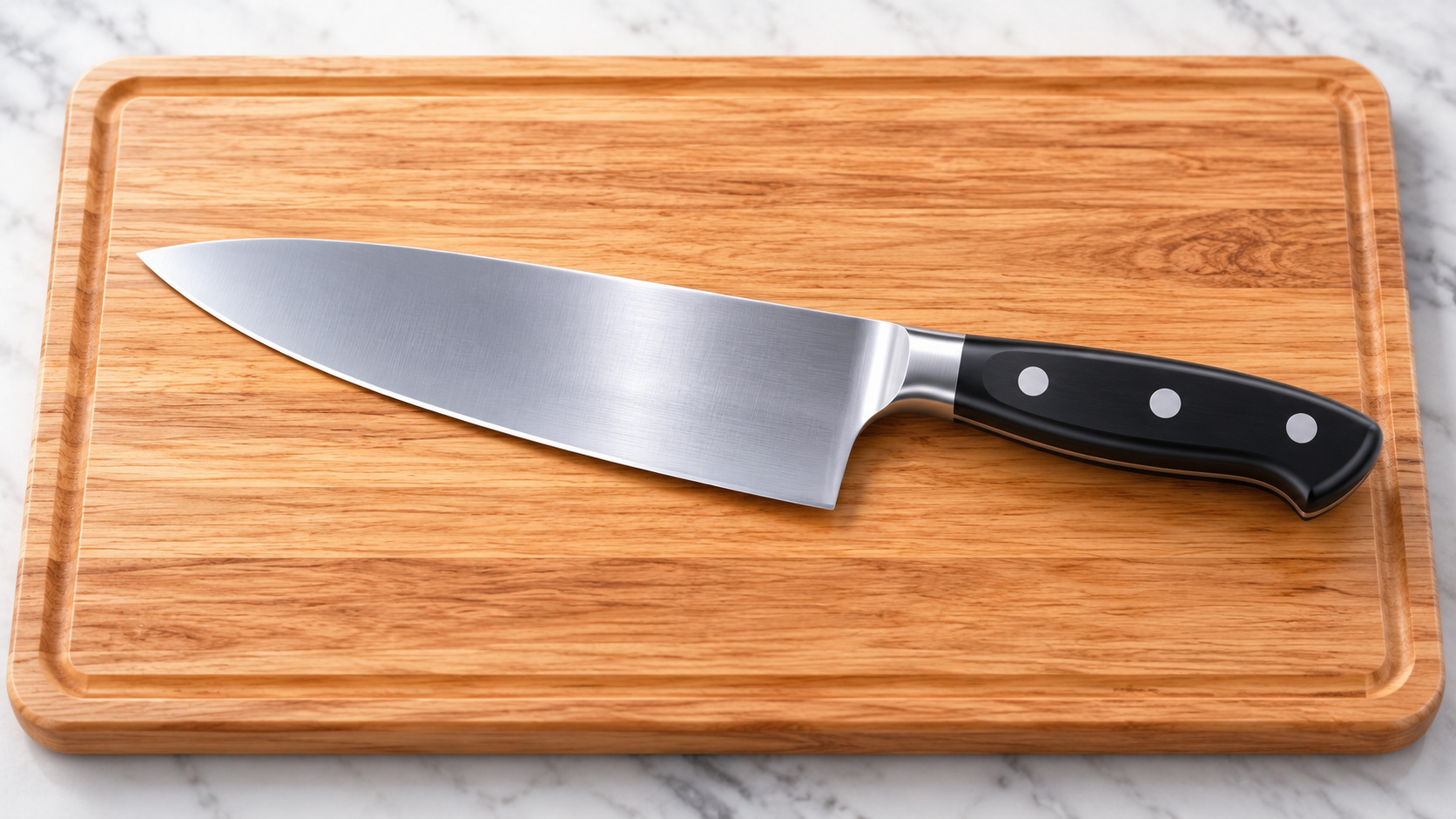
The steel a knife is made from determines almost everything about how it performs: how sharp an edge it can take, how long that edge lasts, how easy it is to sharpen at home, and how much maintenance it demands. Two names come up constantly in conversations about premium Japanese kitchen knives — VG10 and SG2 — and both are made by the same manufacturer, Takefu Special Steel in Echizen, Japan, yet they perform noticeably differently once ground into a blade.
Steel matters more than blade shape or brand name when it comes to day-to-day cutting performance. Two knives with identical geometry — same length, same grind angle, same handle — can feel completely different in use if one is made from a soft, budget stainless steel and the other from a premium alloy like VG10 or SG2. Harder steels generally hold a finer edge for longer, which means less time spent sharpening and more consistent cutting performance between sessions. But hardness comes with tradeoffs: harder steel is typically more brittle and more time-consuming to sharpen, which is exactly the balance VG10 and SG2 sit on opposite ends of.
This guide breaks down the composition, hardness, and practical characteristics of each steel, based on manufacturer data and established industry knowledge, so you can decide which one actually matters for how you cook.
If you’re still deciding on a knife shape before worrying about steel, see our guides to the best Japanese chef knives and gyuto vs santoku. Once you’ve chosen a knife, our guide to the best whetstones for Japanese knives covers what you’ll need to keep either steel properly sharpened.
[Image suggestion: side-by-side steel comparison chart showing VG10 and SG2 key stats]
What Is VG10?
Composition: VG10 is a stainless steel containing roughly 1% carbon, approximately 15% chromium, along with molybdenum, vanadium, and cobalt. The chromium content is high enough to classify it as fully stainless, since any steel above roughly 12.5% chromium qualifies for that designation. The cobalt addition is somewhat unusual among stainless knife steels and is generally credited with boosting hardness and edge retention beyond what the carbon and chromium content alone would provide.
Hardness: VG10 typically hardens to 60–62 HRC on the Rockwell scale, depending on the specific heat treatment a manufacturer applies. This is a well-established, moderately high hardness range that balances a sharp, durable edge with a manageable sharpening experience.
Advantages:
- Strong corrosion resistance thanks to its high chromium content
- Very good edge retention relative to mid-range stainless steels
- Long track record and wide availability across knife brands and price points
- Relatively well understood by home sharpeners, since it’s been a standard premium steel for decades
Disadvantages:
- More difficult to sharpen than softer stainless steels like AUS-8 or 440C, though less demanding than SG2
- Edge retention, while good, falls short of powder metallurgy steels like SG2
- Can be prone to minor chipping at very thin edge angles if used on hard surfaces
What Is SG2?
Powder Steel Characteristics: SG2 (also marketed as R2, SGPS, or MC66 depending on the manufacturer) is a powder metallurgy stainless steel, also produced by Takefu Special Steel. Rather than being cast in the traditional way — melting steel and pouring it into a mold — powder metallurgy atomizes molten steel into a fine powder, then re-consolidates it under heat and pressure. This process produces a much finer, more evenly distributed carbide structure than conventional casting, which is the main reason SG2 outperforms cast steels like VG10 despite sharing a similar base chemistry.
Composition: SG2 contains roughly 1.25–1.45% carbon, around 15% chromium, plus tungsten, molybdenum, and vanadium — a composition broadly similar to VG10 but with higher carbon content and the added benefit of the powder metallurgy process.
Hardness: SG2 typically hardens to 62–64 HRC, noticeably higher than VG10, with some sources citing hardness up to 65 HRC depending on heat treatment.
Advantages:
- Superior edge retention — commonly cited as roughly twice the working sharpness duration of VG10 under similar home use conditions
- Fine, even carbide structure that resists chipping better than its high hardness would otherwise suggest
- Fully stainless, with corrosion resistance comparable to VG10
- Capable of holding very thin, acute edge angles due to its fine grain structure
Disadvantages:
- More difficult and time-consuming to sharpen, generally requiring finer stones and more patience than VG10
- Higher hardness makes it somewhat less forgiving of improper sharpening technique
- Knives made from SG2 typically carry a higher price premium than comparable VG10 knives
Quick Comparison Table
| VG10 | SG2 | |
|---|---|---|
| Hardness (HRC) | 60–62 | 62–64 |
| Edge Retention | Very good | Excellent |
| Toughness | Good | Good, despite higher hardness |
| Corrosion Resistance | High (stainless) | High (stainless) |
| Sharpening Difficulty | Moderate | Higher |
| Price | Mid-premium | Premium |
[Image suggestion: hardness graph showing VG10’s 60-62 HRC range next to SG2’s 62-64 HRC range on a Rockwell scale]
Why Powder Metallurgy Makes a Difference
The distinction between how VG10 and SG2 are manufactured is worth understanding, since it explains most of the performance gap between them. Conventional steels like VG10 are produced by melting the alloy and casting it into ingots, which are then forged and rolled into the sheet or bar stock knife makers use. This process works well, but it tends to produce carbides — the microscopically hard particles within the steel that actually do the cutting at an edge — that are relatively large and unevenly distributed throughout the metal.
Powder metallurgy, the process behind SG2, takes a different approach. Molten steel is atomized into a fine powder using high-pressure gas, then re-consolidated under heat and pressure into a solid billet. Because the powder particles are so small to begin with, the carbides that form during this process are both finer and far more evenly distributed than what casting produces. In practical terms, this means an SG2 edge can be ground thinner and sharper without the larger carbides tearing out or causing micro-chipping — the same property that allows it to be pushed to a higher hardness (62–64 HRC) without becoming excessively brittle, something that would be riskier with a conventionally cast steel at the same hardness level.
[Image suggestion: microscopic structure illustration comparing cast steel’s larger, uneven carbides to powder steel’s fine, uniform carbide distribution]
VG10 vs SG2: Side-by-Side Comparison
Edge Retention
SG2’s finer, more evenly distributed carbide structure — a direct result of the powder metallurgy process — gives it a meaningful edge retention advantage over VG10. Under comparable home use with regular honing, SG2 is commonly reported to hold a working edge roughly twice as long as VG10 before requiring a full resharpening. VG10 still offers solid edge retention relative to more basic stainless steels, but it falls short of SG2’s performance in this specific category. For a home cook who sharpens on a set schedule regardless of need, this difference may matter less; for someone who sharpens reactively, once the knife starts to feel dull, SG2’s extended edge life means noticeably fewer sharpening sessions per year.
Ease of Sharpening
VG10 is generally considered more approachable for home sharpeners. Its 60–62 HRC hardness is high enough to hold a good edge but low enough that a standard 1000-grit whetstone can restore it in a reasonable amount of time. SG2’s higher hardness (62–64 HRC) demands more time, more consistent technique, and often a finer finishing stone to achieve the same results — the tradeoff for its superior edge retention is a steel that asks more of the person sharpening it. This doesn’t mean SG2 is difficult to sharpen in an absolute sense; its fine, uniform carbide structure actually sharpens fairly cleanly once you have the patience and the right stone. It simply takes longer to remove the same amount of material compared to a softer steel.
Rust Resistance
Both steels are fully stainless, with chromium content around 15% in each case, and both offer comparable corrosion resistance. Neither is entirely rust-proof — proper drying and storage remain important for both — but day-to-day rust risk is not a meaningful differentiator between the two. Cooks deciding between VG10 and SG2 generally don’t need to weigh corrosion resistance heavily in the decision, since both perform similarly well in this category compared to non-stainless carbon steel alternatives.
Price
VG10 knives generally sit in the mid-premium range, reflecting the steel’s decades-long availability and widespread use across many knife brands and price tiers. SG2 knives typically command a higher price, both because of the more complex and costly powder metallurgy production process and because SG2 is more frequently reserved for higher-end knife lines. It’s common to see the same knife maker offer a VG10 version and an SG2 version of a similar model, with the SG2 edition priced noticeably higher purely on the strength of the steel upgrade.
Best for Beginners
VG10 is the more beginner-friendly steel, primarily because of how much easier it is to maintain. A new Japanese knife owner who hasn’t yet invested in a full whetstone sharpening routine will generally have an easier time keeping a VG10 edge in good condition than an SG2 edge. It’s also simply easier to find well-reviewed, moderately priced VG10 knives, since the steel has been a mainstream premium option for far longer than SG2.
Best for Enthusiasts
SG2 tends to appeal more to knife enthusiasts and cooks who already have a sharpening routine in place and want to extend the time between full sharpening sessions. The extra edge retention rewards cooks who use their knives heavily and value fewer sharpening interruptions, provided they’re equipped to handle the more demanding sharpening process when it’s needed. SG2 is also popular among cooks who enjoy the sharpening process itself and see the steel’s higher hardness as an opportunity to refine their technique rather than an inconvenience.
Where You’ll Find These Steels
VG10 has been used across a wide range of Japanese knife brands and price points for decades, often as the core steel in Damascus-clad knives, where a VG10 center is sandwiched between layers of softer, patterned stainless steel for both visual effect and added flexibility near the spine. SG2 — sometimes branded as R2, SGPS, or MC66 depending on the manufacturer — tends to appear in higher-end product lines, including several well-known premium Damascus series, reflecting its positioning as a step above VG10 in most manufacturers’ lineups. Because both steels come from the same Japanese mill, it’s not unusual to see the exact same knife model offered in both a VG10 and an SG2 version, which makes for a useful direct comparison when shopping.
Which Steel Should You Choose?
Best Overall: VG10
For most home cooks, VG10 offers the strongest overall balance — very good edge retention, solid corrosion resistance, and a sharpening experience that doesn’t require specialized equipment or advanced technique.
Best Budget: VG10
Because VG10 has been a standard premium steel for decades, it’s available across a wide range of price points and knife brands, making it easier to find a well-made VG10 knife without paying SG2-level premiums.
Best Premium: SG2
For cooks who want the longest possible edge retention and don’t mind investing more time — and typically more money — into both the knife and the sharpening equipment to maintain it properly, SG2 represents the more premium option of the two.
Both steels are made by the same manufacturer and share a broadly similar chemical foundation, so the choice between them comes down less to quality and more to how much sharpening effort you’re willing to put in for the edge retention gains SG2 offers. Once you’ve chosen, our guide on how to care for Japanese knives covers maintenance practices that apply to both steel types.
FAQ
Is SG2 worth the extra cost?
For cooks who use their knives heavily and want to minimize how often they need a full resharpening, SG2’s roughly doubled edge retention can justify the added cost. For more casual home cooks, the price difference may not translate into a noticeable day-to-day benefit.
Is VG10 good for beginners?
Yes. VG10’s moderate hardness makes it easier to sharpen on a standard whetstone without specialized equipment, and its long track record means it’s widely available in well-made knives at accessible price points — a practical combination for someone new to Japanese knives.
Which steel stays sharp longer?
SG2 generally holds a working edge longer than VG10, largely due to its finer, more evenly distributed carbide structure from the powder metallurgy process. Under similar home use conditions, SG2 is commonly cited as offering roughly twice the edge retention of VG10.
Is SG2 harder to sharpen?
Yes. SG2’s higher hardness (62–64 HRC compared to VG10’s 60–62 HRC) generally requires more time, a more consistent angle, and often a finer stone to fully restore the edge, making it a steel better suited to sharpeners who already have some whetstone experience.
Can VG10 and SG2 both be used in Damascus-clad knives?
Yes. Both steels are commonly used as the core steel in Damascus-clad knives, where a harder cutting-edge steel is sandwiched between layers of softer, often patterned stainless steel. The Damascus cladding doesn’t change the core steel’s cutting performance — it primarily adds visual appeal and a small amount of flexibility near the spine.
Does higher hardness always mean a better knife steel?
Not necessarily. Hardness is one factor among several — toughness, edge stability, and ease of maintenance all matter too. SG2’s powder metallurgy structure lets it reach a higher hardness without the brittleness that a conventionally cast steel might show at the same HRC level, which is why it performs well despite being harder than VG10. A steel that’s simply hard without a supporting microstructure can be more prone to chipping.
Final Verdict
VG10 and SG2 come from the same Japanese steel manufacturer and share a similar underlying chemistry, but the powder metallurgy process behind SG2 gives it a real, measurable edge in hardness and edge retention — at the cost of a more demanding sharpening process and a higher price. For most home cooks, especially those newer to Japanese knives, VG10 offers the more practical balance of performance and maintainability. For enthusiasts who already sharpen regularly and want to push edge retention further, SG2 delivers a genuine upgrade, provided you’re equipped to sharpen it properly when the time comes.
This article compares composition, hardness, and performance characteristics of VG10 and SG2 steel based on publicly available manufacturer data and established industry knowledge. Individual results can vary based on knife geometry, heat treatment, and sharpening technique.
Comment